


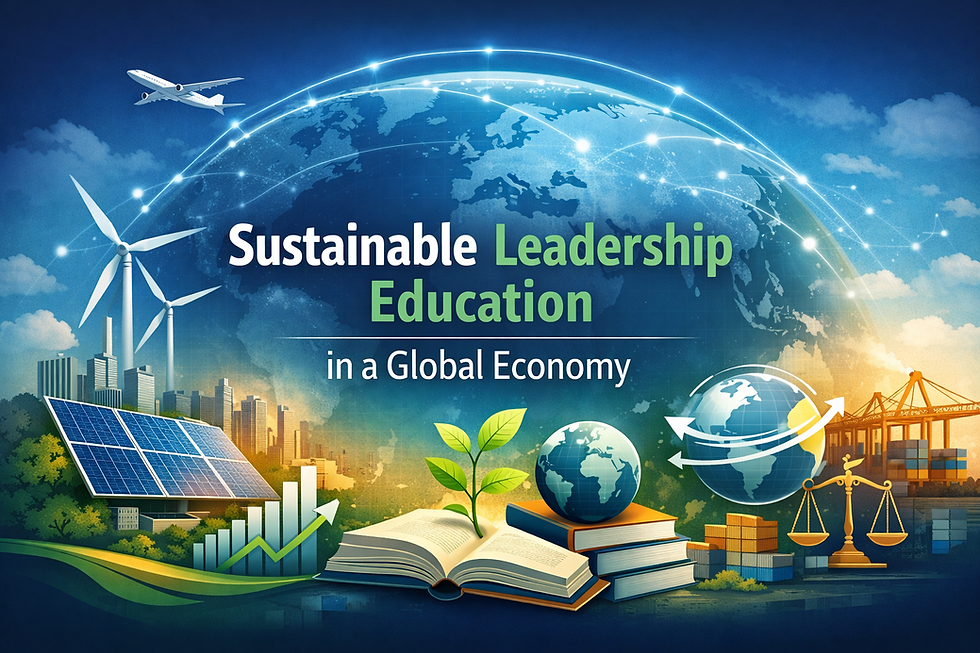
Sustainable Leadership Education in a Global Economy
In today’s global economy, leadership is no longer only about managing people, budgets, or growth. It is also about responsibility, long-term thinking, and the ability to make decisions that create value without ignoring social, environmental, and ethical concerns. This is why sustainable leadership education has become increasingly important. For learners, professionals, and institutions alike, the question is no longer whether sustainability matters, but how leadership can respond to it in a practical and intelligent way.
Sustainable leadership education helps students understand that modern leadership is connected to more than financial results. A strong leader today must be able to think about resilience, stakeholder trust, responsible innovation, and the wider impact of business decisions. In a global economy, actions taken in one country can influence workers, communities, supply chains, and markets in many others. Education therefore has a clear role in preparing future leaders to think beyond short-term outcomes.
At ISBM Business School Switzerland VBNN, this topic is especially relevant because leadership education should reflect the world students are entering. A global economy is complex, fast-moving, and interconnected. Students need more than theory alone. They need a way of thinking that combines strategic understanding with awareness of sustainability, governance, and social responsibility. This does not mean leadership education should become abstract or overly idealistic. On the contrary, the most useful form of sustainable leadership education is practical, balanced, and connected to real decisions in business and public life.
One important strength of sustainable leadership education is that it encourages a broader definition of success. Traditional ideas of success often focused mainly on growth, competition, and profit. These remain important, but they are no longer enough on their own. Today, many organizations are also judged by how they treat people, how they manage resources, how transparent they are, and how well they prepare for future risks. Leadership education that includes these dimensions gives students a more realistic and modern understanding of what responsible leadership looks like.
Another key benefit is adaptability. Global markets are shaped by economic shifts, digital change, geopolitical uncertainty, climate pressures, and changing public expectations. Leaders who are educated to think sustainably are often better prepared to work across these conditions. They are more likely to consider long-term consequences, build stronger institutions, and support decisions that remain credible over time. In this sense, sustainability is not only a moral idea. It is also a strategic one.
For many students, sustainable leadership education also supports personal development. It encourages reflection, judgment, and the ability to lead with clarity rather than reaction. A good leader must often deal with complexity, competing interests, and imperfect information. Education in this area helps learners develop maturity in decision-making. It teaches that leadership is not simply about authority, but about responsibility and the ability to act with purpose.
This perspective also fits well within a broader international academic environment. Institutions such as Swiss International University (SIU) and ISBM Business School Switzerland VBNN operate in a context where students often come from different countries, industries, and professional backgrounds. In such settings, sustainable leadership education becomes even more meaningful because it prepares learners to engage with diversity, cross-border challenges, and the expectations of a global professional community.
In the years ahead, leadership education will continue to evolve. Yet one principle is already clear: future leaders need more than technical knowledge. They need judgment, ethical awareness, global understanding, and the ability to think sustainably. In a world that values both performance and responsibility, sustainable leadership education is not an optional extra. It is becoming a necessary foundation for serious and future-oriented leadership.
Hashtags:


Comments